|
|
|
The series of plates covered by the Gardiner Hill Collection is probably
the least studied area of the line-engraved issues. The reason for this is
two-fold.
Firstly, until the National Postal Museum (NPM) made available
photographs of the Imprimatur Sheets there was no information for would-be
platers other than that obtained from examination of multiples. Multiples
of this group of plates are scarce as the perf 16 makes separation of the
stamps an easy matter and the survival of the multiples less likely. Also
the issue of the embossed high values reduced the need for multiples of
the 1d stamp. The scarcity of the multiples made the attempted
reconstruction of these plates virtually impossible so the issue did not
receive the degree of attention that was given to earlier line-engraved
plates.
Secondly, the stamps of this issue are far scarcer than is generally
realised. From the start of the official perforation in February, 1854
until the advent of the Die II plates in February, 1854 (i.e. one year)
some 51 plates were used. This contrasts with the imperf alphabet II
stamps where 46 plates were used in two years. Some of this increase in
the number of plates used could be due to an increasing demand for the 1d
stamp but this would be countered by the issue of higher value stamps
reducing the demand. The main reason for the increase in the number of
plates used is most probably due to wear on the dies used for making the
plates reducing the depth of the engraving which reduced the life of the
plates. This scarcity factor due to the reduced life of the plates is
compounded by the difficulties encountered in perforating the sheets.
Apart from teething troubles invariably encountered when a new process is
introduced there was a major problem caused by the irregular layout of the
plates. If one looks at the Imprimatur photographs of almost all these
plates it becomes immediately obvious that there is no way that the sheet
can be perforated by a regular perforating comb to give well-centred
copies of the stamps. Spacings vary from adjacent impressions almost
touching to gaps wider than the corner squares. On some plates it is
likely that less than 10% of the stamps were reasonably perforated even
when the perforating machine was working correctly. Off-centred stamps are
not popular with collectors so it is likely that many of these stamps were
discarded as faulty by earlier collectors. It is possible that on some
plates certain letterings cannot exist in well-centred condition.
The achievement of Dr.Gardiner-Hill in reconstructing some 90% of the
letterings of all but the scarcer plates should not be underestimated.
When the plating of the collection was checked by Dr.Statham it was found
that a small number of the stamps were misplated but this is likely to be
the case whenever any plating is checked. To make only this small
number of errors when plating this difficult issue was a remarkable
achievement.
In checking the collection there was a problem on some letterings that
had been removed from the Imprimatur sheets. On all of the plates
of this issue some 21 copies were removed at various times for official
purposes. Some of these copies are in the collection of Her Majesty, the
Queen, the British Library or the National Postal Museum. Other copies
have come on the market but the whereabouts of almost one third of them is
not known. These letterings can only be identified from multiples and as
these are scarce there are some letterings that it has not been possible
to check. The letterings missing from the Imprimatur sheets are given in
Part 1 of the Stanley Gibbons Specialised Catalogue. When the collection
was checked any letterings missing from the Imprimatur sheets that could
be shown to be correct were marked by a tick (b)
and any lettering believed to be wrong were marked with a cross (x).
Items that could not be checked were left unmarked. In view of the high
degree of accuracy in Dr.Gardiner-Hill's plating the probability is that
the unmarked items are correct. It is also possible that the items marked
with a cross could, in fact, be correct so they have been left in the
position in the collection. The reason for this is that some of the
Imprimaturs in the reference collections or in the possession of
individual collectors may have been incorrectly labelled over the years
since they were removed from the Imprimatur sheets. An example of this can
be seen in the Phillips collection in the NPM where the Imprimatur for Die
1 plate 13 is from the A row when in fact this row is still present on the
Imprimatur sheet. Other examples have been found or suspected.
An added complication with this issue is that some of the plates were
repaired leading to the second or even third states. In some cases the
check letters were retouched or even re-punched in a different position
and this accounted for a few of the cases of misplating that were found.
The plates mainly affected were 155, 157, 162-5, 170, 172, 173, and 176
and the extent of the repairs is still being investigated.
It is not generally realised that the Imprimatur sheets were endorsed in
ink on the back and that in many cases this ink shows through on the front
of the sheet and in the photographs it also masks some of the check
letters and also produces some very interesting “varieties”.
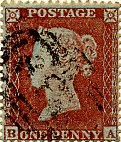
The First Major Perforated Issue is certainly a lovely souvenir of the
work done by Dr.Gardiner-Hill but a worthwhile basis for either the
collector who wants one copy from each plate or the specialist.
Many letterings include varieties (some as yet unrecorded), missing perf
pins and copies of the Perf 14 C2 series.
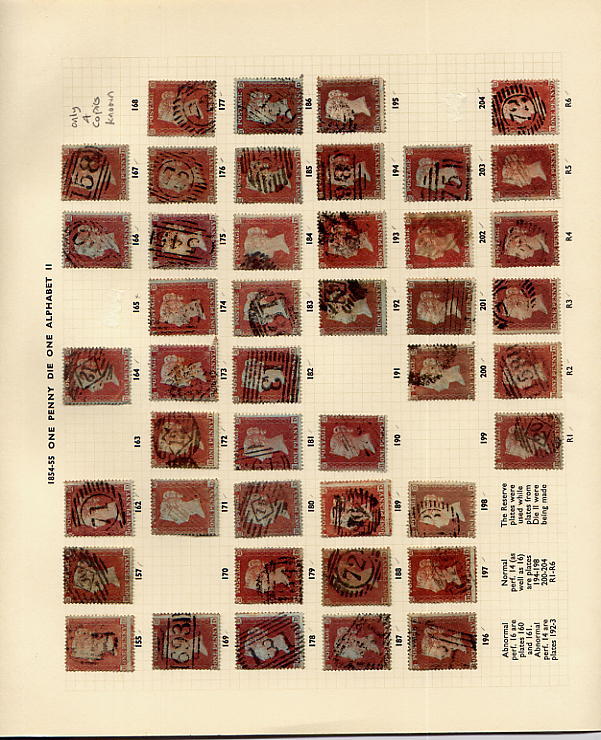
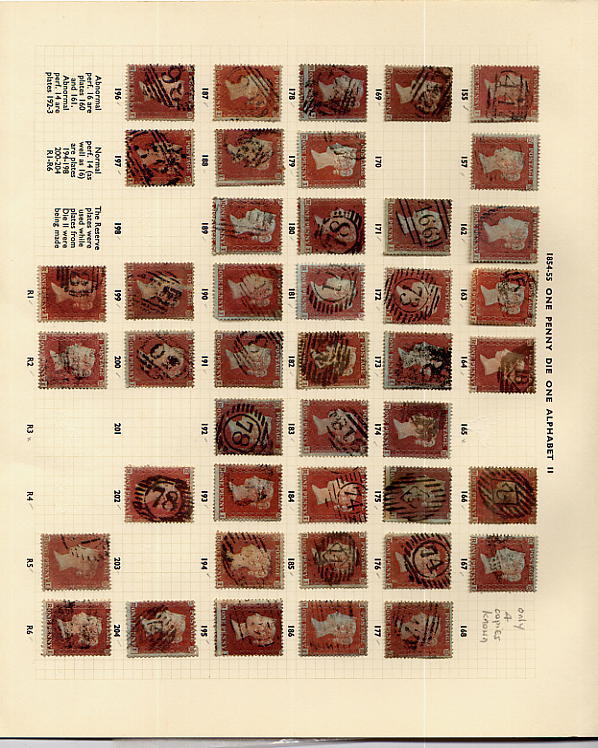
Plate 168 is extremely scarce and is not included in any of the sets.
Only 4 copies have been recorded. We regret we do not have any in stock at
the moment.
A full price list of individual letterings still available is given
below. The red figure gives the number of stamps on the page (maximum 50
as plate 168 is extremely scarce) and the black figure is the price for
the page. The price is based on the number of stamps, the plates included
and the condition of the stamps.
| A | B | C | D | E | F | G | H | I | J | K | L | ||
| A | A | ||||||||||||
| B | 45 £300 | 22 £225 | 44 £350 | B | |||||||||
| C | 43 £325 | 45 £325 | C | ||||||||||
| D | 42 £375 | 45 £450 | 45 £425 | 46 £450 | 40 £300 | D | |||||||
| E | 41 £300 | 43 £300 | 45 £300 | 44 £300 | 40 £350 | 39 £300 | 41 £300 | 42 £300 | 28 £250 | E | |||
| F | 40 £300 | 39 £400 | 42 £350 | 46 £300 | 46 £350 | 44 £350 | 40 £300 | 43 £300 | 41 £400 | 43 £400 | F | ||
| G | 45 £350 | 45 £500 | 45 £500 | 42 £400 | 41 £400 | 39 £300 | G | ||||||
| H | 37 £250 | 44 £300 | 39 £250 | 42 £350 | 34 £350 | 42 £300 | 44 £450 | 38 £350 | H | ||||
| I | 38 £275 | 43 £300 | 40 £450 | I | |||||||||
| J | 39 £300 | 43 £375 | 44 £375 | 38 £325 | 40 £450 | 38 £275 | J | ||||||
| K | 41 £350 | 42 £350 | 44 £400 | 48 £500 | 43 £400 | 35 £400 | 38 £450 | 30 £350 | K | ||||
| L | 40 £350 | 42 £400 | 43 £400 | 40 £400 | 39 £400 | 39 £400 | L | ||||||
| M | 41 £375 | 42 £375 | 40 £375 | 40 £450 | 35 £300 | 41 £350 | M | ||||||
| N | 42 £450 | 33 £300 | 43 £500 | 42 £375 | 41 £375 | 42 £300 | 41 £400 | 45 £400 | 45 £375 | 44 £400 | 40 £375 | N | |
| O | 42 £350 | 41 £400 | 44 £400 | 39 £350 | 27 £150 | 31 £200 | 38 £375 | 41 £375 | 41 £375 | O | |||
| P | 40 £375 | 41 £400 | 37 £400 | 38 £450 | 42 £400 | 45 £400 | 29 £375 | 35 £350 | P | ||||
| Q | 40 £500 | 39 £400 | 43 £400 | 42 £350 | 44 £400 | 45 £375 | 43 £400 | 43 £375 | Q | ||||
| R | 44 £375 | 44 £375 | 43 £400 | 40 £450 | 36 £350 | R | |||||||
| S | 40 £350 | 42 £375 | 40 £375 | 35 £275 | 40 £350 | S | |||||||
| T | 38 £275 | 46 £400 | 42 £375 | 43 £400 | T | ||||||||
| A | B | C | D | E | F | G | H | I | J | K | L |
To view an image of the page lettered RD and RI please click on the the
box in the table with those letters.
To order a lettering please press the button below...